HumanPhenotypes
Anthropometric trait

Relative Trunk Length

One of the most important, but often overlooked anthropometric features, is relative trunk length. It is particularly useful when comparing African groups or populations on a global scale. It is synonymous with relative leg length and sitting height, and is measured by the cormic or scelic index. On the population level, sitting height varies from 45 to 56 percent of standing height. The length of the legs often contributes more to height than trunk length itself. Thus, the smallest humans, the short-legged African Pygmies, have trunks only slightly shorter than their long-legged Nilotic neighbours. The cormic index is often more useful to determine the racial group than is the much more prominent skin colour. Mongoloids usually show relatively short legs, Caucasoids, Americanids, and Capoids legs of medium length, and Negroids as well as Australoids long legs - apart from Pygmies. Relative trunk length seems to be one of the primary human adaptions. It developed during the Paleolithic as response to climate conditions. In cold climate, short limbs and large bodies are favourable, in hot climates sweating is more efficient in long lean bodies with long limbs (Allen's rule). Later during the Neolithic, when humans used clothing, trunk length hardly continued to change - in difference to many other anthropometric traits. On this site, five categories of relative trunk length are used: hypermacroskelic (very great relative trunk length, very short relative leg length), macroskelic (great relative trunk length, relatively short legs), mesoskelic (average relative trunk length, legs of medium length), brachyskelic (short relative trunk length, legs of long length), hyperbrachyskelic (very short relative trunk length, very long legs).
hypermacroskelic distribution

hypermacroskelic

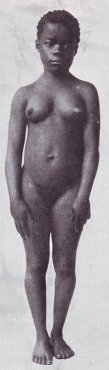
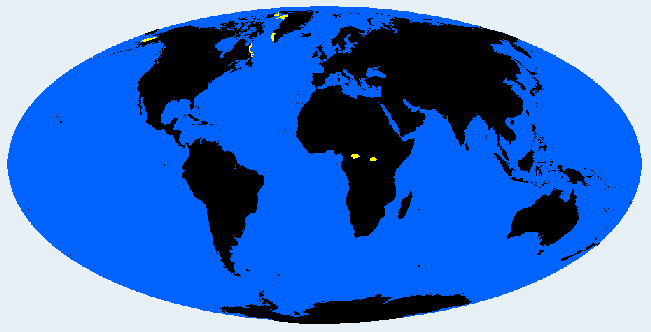
In hypermacroskelic individuals the sitting height is greater than 55 percent of the overall height. Hypermacroskelia on the population level is very rare. It has been identified with an average cormic index of 55.5 on BaBinga Pygmies of N'Gali, as well as Yupik of South Alaska with an index of 55.4. As not all Bambutid and Eskimid populations have been studied, one can assume that it is found in similar groups. In the African forests the short legs are associated with very short stature. Here the air is hot and humid so that sweating is inefficient, and small stature limits the heat during exertion. However, Asian Negritos do not show such high cormic indices. The short limbs in Arctic regions combined with a large trunk offer a better protection against the cold (Allen's rule).
macroskelic distribution

macroskelic

Macroskelic individuals have a sitting height between 53 and 55 percent of their overall height. Macroskelia is common in North and East Asia and a typical trait of many Mongoloids. Apart from that, it occurs in some Caucasus groups and a few Southern as well as Eastern Europeans. It is more common in parts of North America, especially in groups that came with the later migrations from Asia (Pacifids, Eskimids). Apart from that, it is not very common in native America, although in Fuegians a partial adaption to cold climate has taken place with shortening of the limbs. In the African forests, great relative trunk length is common in Pygmies. The short limbs of most Mongoloid groups are thought to have evolved during the Paleolithic when an ancestral population adapted to the cold climate of Central Asia (Allen's rule). It seems that Proto Mongoloid groups were still mesoskelic.
mesoskelic distribution

mesoskelic

Mesoskelia is defined by a sitting height between 51 and 53 percent of overall height, which corresponds to an average trunk-leg ratio within worldwide standards. It is a very widespread trunk-leg ratio. Most Europeans are mesoskelic, as well as most North African and Near Eastern populations. In Africa, most Guinean and Bantu speakers of the rainforest belt are mesoskelic as well as Khoisanids and Madagascans. Most of Indochina, Indonesia, and Polynesia is mesoskelic as well. In North Asia it is mainly found in Ainu. Apart from that, the great majority of Native American groups is mesoskelic on average.
brachyskelic distribution

brachyskelic

Brachyskelic individuals have a sitting height between 49 and 51 percent of their overall height. Brachyskelia is widespread in the tropics but appears to be rare in cold regions. This trait is a response to heat where sweating is efficient, so that bodies with a higher surface have an advantage (Allen's rule). Most Sub-Saharan Africans show brachyskelia, except for the forest populations and Khoisanids. Several Saharan populations (Tuareg) show brachyskelic proportions as well. Outside of Africa it is common in India, New Guinea, and Australia. Brachyskelia hardly developed in the American tropics, because they were only inhabited since the late Paleolithic when humans faced different selective pressures, thus trunk length can be seen as a primary adaption.
hyperbrachyskelic distribution

hyperbrachyskelic

Hyperbrachyskelic individuals have a very short torso compared to the length of the legs. Their sitting height is below 49 percent of their overall height. Hyperbrachyskelia is only found in dry hot regions, where a larger body surface makes sweating more efficient. It is an example of Allen's rule. Hyperbrachyskelia is common in Australian natives, especially those of the northern regions of the continent. It is also present in the related New Caledonians, the Kanak, as well as Vedda. However, the strongest hyperbrachyskelia is found on the continent that also possesses the strongest hypermacroskelia: Africa. Some Nilotic tribes of the Upper Nile may show a cormic index as low as 45.7. Apart from Nilotes, the trait sporadically appears in Sudanids and Ethiopids.