HumanPhenotypes
Anthropometric trait

Nasal Index

The nasal index is the ratio of nasal breadth to nasal length. It varies greatly among different anthropological groups and in different climate zones. In dry climates, noses often (not always) tend to be narrower. E.g. from Arabia to West Asia, as well as North and East Africa. This may be because narrow noses have a better dust-filtering function, and the risk of dehydration of the nasal mucosa is lower. An even more significant pattern is the high frequency of narrow noses in cold climate. It has been suggested that longer, narrower noses can better heat and moisten inhaled air in cold climate (Thomson's Nose Rule).
When a person inhales, more air comes into contact with the mucosal surface of the nose, which provides moisture, and a narrow nose maximises the surface area. In humid, hot climate, noses are often wide. Without any restrictions like cold or dusty air this is simply the most efficient nose for breathing.
Unfortunately, the nasal indices published by different authors are not always comparable, because of different measuring techniques. This is sometimes ignored. While on the skull the measurement of the craniological index is common, for living individuals various techniques exist. German anthropologists often used the morphological nasal index, Italian anthropologists the physiognomic nasal index. The table below shows the most commonly used nasal indices and the classification into narrow (leptorrhine), medium-wide (mesorrhine) and wide (platyrrhine or chamaerrhine).

Nasal index classification of different measuring techniques:
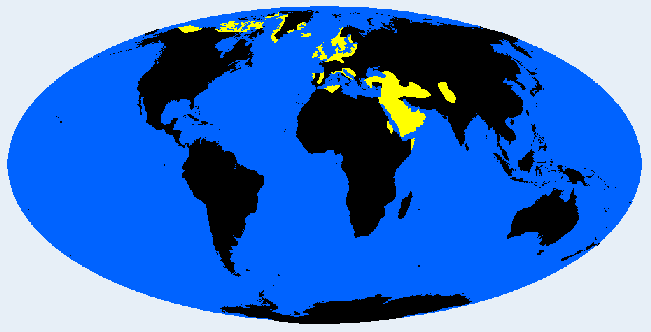
hyperleptorrhine (very narrow) distribution

hyperleptorrhine (very narrow)

Hyperleptorrhine (very narrow) noses generally appear in cool or cold regions, or alternatively very dry regions. The smallest craniological nasal index can be found in Inuit of Arctic North America, the coldest inhabited regions of Earth. Another area of hyperleptorrhiny lies in West Asia, where some subgroups of Assyrians, Lurs, Armenians, Jews, Persians, and Arabs reach very low nasal indices. In Europe, very low nasal indices are common in three different groups: firstly some (but not all) Northwest Europeans, Gracile Mediterranean people, as well as groups of the Dinaric Alps. Hyperleptorrhiny is also found in North West India (e.g. in Sikh), as well as parts of North Africa and East Somalia.
leptorrhine (narrow) distribution

leptorrhine (narrow)

Leptorrhine (narrow) noses are very common and appear in almost all non-tropical regions of the Northern Hemisphere. Most Europeans show leptorrhine noses as well as many people from India. Much of Siberia and China is leptorrhine just like most Turkic groups. Towards South East Asia leptorrhiny becomes rarer. Much of the arid regions in North and East Africa are leptorrhine (e.g. it is typical for Ethiopids). It also dominates in most cool and temperate regions of North America, from the Plains to the forest, and only becomes rarer in the subtropical areas (e.g. Mexico). Similarly, in South America leptorrhiny appears mainly in regions with subtropical or temperate climate. Thus, leptorrhiny dominates in Patagonians and many groups of the Southern Andes.
mesorrhine (medium-wide) distribution

mesorrhine (medium-wide)

Mesorrhine noses show an average width to length ratio. Unlike for several other anthropometric traits, for the nasal index, the average category is barely more frequent than the other categories. In Africa, mesorrhine groups are mostly found in a long contact belt between Caucasoid desert groups and Sub-Saharan groups. Mesorrhiny sporadically appears in Siberia, and is common in tribals of India. It dominates in all of South East Asia except for some Indochinese mountain groups and people of the interior of Borneo. Mesorrhiny is typical for Polynesians as well, and the most common nasal index in all of tropical Native America.
platyrrhine (wide) distribution

platyrrhine (wide)

Platyrrhine noses dominate in all groups which have long been native to humid tropical climate. An exception is people of America and South-East Asia, as the native groups there stem from comparatively recent migrations (a few millennia old) from the North. Much of Sub-Saharan Africa is platyrrhine, from the moist savannahs of the North to the rainforests and the southern steppes as well as large parts of Madagascar. In Asia, platyrrhiny is often only mild. It is found in some ancient Indian tribal groups, as well as Dayaks and some Indochinese mountain tribes. Platyrrhiny dominates throughout New Guinea and Melanesia, and most of South Australia. In America only a few Lagoid groups of the tropics as well as the oldest Californian tribes show platyrrhiny.
hyperplatyrrhine (very wide) distribution

hyperplatyrrhine (very wide)

In hyperplatyrrhine noses, the nasal breadth may exceed the nasal length. In some cases, the nose may even be wider than the mouth. The most hyperplatyrrhine groups are found in Pygmoids of Central Africa, e.g. Mbuti and Twa. Equally wide are the noses in the Karoo steppe of South Africa, e.g. in Khomani, and also some Australia Aboriginals of the Western Desert and Arnhem Land. Hyperplatyrrhiny in slightly lower frequencies occurs throughout most of Sub-Saharan Africa from Sudanids to Khoids and Bantuids. The New Caledonians (in Melanesia) and the extinct Tasmanian natives often show hyperplatyrrhiny as well.