HumanPhenotypes
Anthropometric trait

Height-Length index

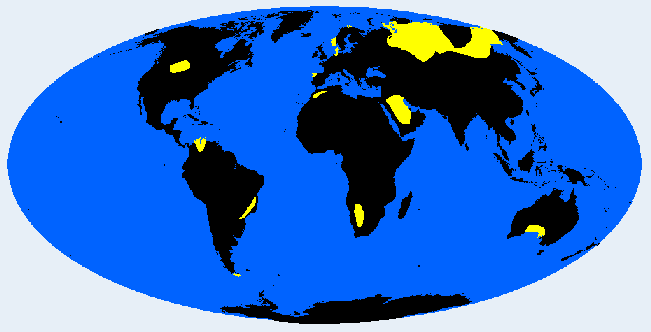
Much less prominent than the cephalic index, but of similar anthropological value, is the height-length index. It measures the skull height in relation to skull length. The variation on the individual level within populations is usually greater than in the cephalic index, but the height-length index is much less affected by the environment. Thus, processes such as (de-)brachycephalisation hardly alter the height-length index. The world's average height-length index lies around values of 74. It may get as low as 67 in population means and as high as 80 in others. On this site, the height-length index is divided into three categories: chamaecrany (low skulls), orthocrany (medium-high skulls), and hypsicrany (high skulls). On living individuals, the terms chamaecephaly, orthocephaly, and hysicephaly may be used alternatively, but since it is much harder to take the measurement on living individuals than on the skull, the ending "-cranic" is preferred here. All continents have high-skulled and low-skulled groups. High-skulled groups are often (but not always) characterised by a flat occiput, whereas low-skulled groups often show a protruding occiput. The maps show regions where a specific height-length index category is dominant in population means. However, on the individual level, other categories may appear in the black areas as well.
chamaecranic distribution

chamaecranic

Chamaecranic skulls are characterised by the skull height reaching less than 70 percent of the skull length. This is also called low-skulled. Many early humans, including Neanderthals, were chamaecranic. Today true chamaecrany is rare, but occurs on all continents. In Africa it is most common in Khoisan groups, but also appears in some Berbers, in Europe it appears in some coastal regions of Western Europe. Much of Siberia is chamaecranic, as well as parts of Arabia. It also exists in some populations of Southern Australian Aborigines. In America chamaecrany is comparatively rare, but quite typical for various Fuegids, particularly in Botocudos. In North America it shows in some groups of the Great Plains.
orthocranic distribution

orthocranic

Orthocranic skulls are characterised by the skull height reaching more than 70 percent of the skull length, but less than 75 percent. This is also called medium high-skulled. Orthocrany today is widespread on all continents. It dominates throughout Africa, in the western half of Europe, and large parts of South and Central Asia. Much of Australia is orthocranic as well. In North America most groups of temperate and cold climate show orthocrany. In South America it is often transitional to mild hypsicrany, but dominates around the Caribbean.
hypsicranic distribution

hypsicranic

Hypsicranic skulls are characterised by the skull height reaching at least 75 percent of the skull length. This is also called high-skulled. Hypsicranic individuals often have a flat occiput (planoccipital). Although rare in prehistoric times, hypsicrany is widespread today and occurs in most East and South East Asians. It is particularly strong in some Indochinese and Malay groups. Another centre of hypsicrany lies in the Caucasus, Anatolia, and the Balkans. In a somewhat less pronounced form it extends through Russia. Some African savannah groups and populations at the Gulf of Guinea show hypsicrany as well, but usually not in a very pronounced form. In America hypsicrany is strong in some groups native to the Southern US states and in peoples of the Andes. In milder forms it extends through Amazonia, Patagonia, and many parts of Central America.