HumanPhenotypes
Anthropometric trait

Height

Body height, or stature, is an important typological characteristic. The shortest individuals of the tallest populations on Earth are still taller than the tallest individuals in very short populations. On this site, seven categories are used. They range from very short, short, rather short, medium height, rather tall, tall, to very tall. Height varies more than other traits within a population, and traditionally short anthropological types may contain relatively tall individuals and vice versa. Significant height differences exist within the same ancestral groups. In addition, nutrition can alter height. Malnutrition causes individuals to remain below their genetic potential, as well as a monotonous diet in some agricultural societies, e.g. in Europe prior to industrialisation. On the other hand, a healthy hunter-gatherer diet may produce taller individuals. The tallest statures are reached with modern, sugar-rich, calorie-rich diets, despite their negative side effects like obesity and diabetes. The table below shows the typical height variation of the seven categories used for males and females in pre-industrial and post-industrial societies. The first number shows the 10th percentile, e.g. the tallest person of the shortest 10 percent. The second number shows the 90th percentile, e.g. the shortest person of the tallest 10 percent. Thus, the illustrated height ranges encompass 80 percent of the population of the respective height category. Disease may alter height so that individuals become much taller or shorter than they would naturally. The same occurs in particular conditions like castration. Africa has the greatest height variation of all continents. The picture examples below all show Sub-Saharan Africans. The maps show regions where a stature is common in native populations. On an individual level, different heights may regularly appear in the black areas, too.
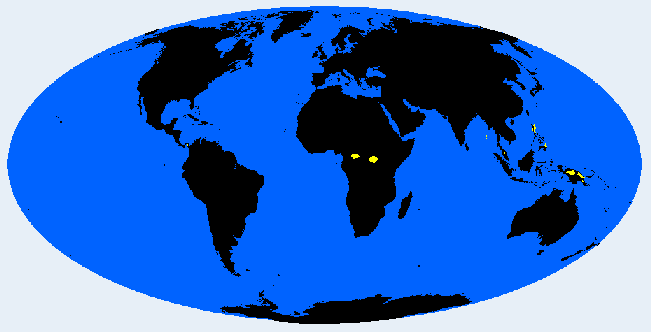
very short distribution

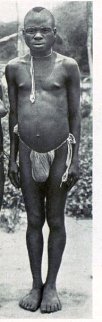
very short

Very short stature occurs in a variety of populations native to different tropical rainforests worldwide. They are also called "Pygmies", the defining criterion for the term being an average height below 150 cm in adult males. By natural selection, groups that have long lived in dense tropical forests tend to become very short. Short stature can be beneficial if there is very dense vegetation, and if the air is hot and humid so that sweating is inefficient, as small stature limits heat during exertion. The shortest population mean ever found in a study is that of the Aiome of New Guinea, where adult men average 138 cm. Only marginally taller are the Mbuti Pygmies of Central Africa. In New Guinea, pygmy stature is common among several mountain tribes like Afere, Tapiro, Nogullo, Kamaweka. It also occurs in the Aeta of the Philippines and Andamanese Negritos. Sometimes in African Mbenga Pygmies and Kuna Indians of Panama.
short distribution

short

Short stature occurs in different populations of all continents. Many live in tropical forest, mountain, or desert regions. Short stature can be beneficial in harsh environments if there is unstable food supply. Besides that, short stature is found in many Arctic regions with extremely cold climate. Here, the trunk is often large, but short limbs offer a great protection against the cold. Native Americans living in forests and mountains from South Mexico to Peru are short. Similarly, Pygmoid groups of the tropical African forests like the Twa and Baka, and the Khoisan of the South African semi-deserts. In India it is frequent in Veddoids. Indochinese mountain groups are short, just like many inland populations of the Sunda Islands and New Guinea. The extinct "Australian Pygmies" were short. In Europe it is found in some South Italians, in North Eurasia in Saami, Ainu, and several Siberians. In North America in several Inuit groups.
rather short distribution

rather short

Rather short stature is defined here as intermediate between medium tall groups and short groups. It occurs in all continents of the world, but most frequently in Asia and South America, and most commonly in moist tropical as well as very cold climates. In Europe, populations of Central Iberia, South Italy and parts of France, Carpathians, and Lapland are rather short. In Africa some Khoisan and Central African groups. Most of Siberia, Indochina, Japan, and Indonesia is rather short, just like many Dravidian groups of India. Many native Mexican and Amazonian groups as well as several Inuits are rather short.
medium height distribution

medium height

Medium tall groups are close to the world's average regarding their genetic height potential. They appear on all continents in all kinds of climates. In some cases, the average height is reached as the local genetic optimum, in some other cases, medium-tall groups were produced by blends of tall and short populations. Most of the Bantu groups of the African forest belt are of medium height, as well as Madagascans. Many Central and Eastern Europeans as well as some South European populations are medium tall, similarly many Oriental, Indian, and North Chinese groups. Southern Australian Aborigines are medium tall. In Native Americans, medium-tall populations exist between the tall and short types.
rather tall distribution

rather tall

Rather tall stature is defined here as intermediate between medium tall groups and tall groups. It occurs on all continents of the world in all kinds of climates. It is common in Africa among Bantu groups of the savannahs, and many North Africans. In Europe, populations of Germany, Ukraine, and Romania are rather tall in large parts, in West Asia many Kurds and Persians, but also Turkic groups and North Indians. It is also found in North China and Northern Australian Aborigines. In North America many Canadian and Rocky Mountain tribes show rather tall height, in South America it can be found in the Pampas and Cuyo.
tall distribution

tall

Tall stature is found in different populations of all continents, but is basically absent in North and East Asia. Many tall populations live in grasslands or temperate forests. Tall stature can be evolutionary beneficial if people hunt large game or control large domestic animals. In addition, in dry heat sweating is efficient, so that long lean bodies have an advantage. Thus, many African savannah and desert populations are tall, from Nilotes and Niger-Congo groups to Tuareg and Somali. Many Northern Europeans are tall, as well as people from the Dinaric mountains. In Asia, only a few Bedouins of Iraq and Iran as well as Sikh may show tall statures, just like a few North Australian Aborigines. In Polynesia tall stature is common. Tall height was typical for many Native North Americans of the Great Plains and the Northern forests. Most Patagonian groups were tall as well.
very tall distribution

very tall

Very tall stature is defined here as showing an average height of more than 180 cm in males in a pre-industrial society. Even the tallest Europeans - Scots and Montenegrins - didn't reach such numbers until a few decades ago. In Africa, on the other hand, a few such populations exist. They are usually extremely slender in build, with thin bodies, short trunks, and very long legs. Their stature evolved by natural selection in response to dry heat where sweating is efficient, so that long lean bodies have an advantage. The tallest ever measured are the Nuer, where men averaged 185 cm. Dinka, Shilluk, Sara, Makari, and Tutsi are only marginally shorter. Outside of Africa, very tall stature combined with massive, thickset bodies could have been present in some inland Patagonian groups. The natives of Rio Chico and Rio Santa-Cruz reached an average of 185 cm just like the Nuer. Some extinct groups could have been even taller.