HumanPhenotypes
Anthropometric trait

Head Size

Besides the cephalic index and height-length index, overall head size can be a useful anthropometric trait. E.g. even though populations experience (de-)brachycephalisation, the head size is often unaffected. This made many authors keep brachycephalised groups of Northern Europe in the Nordid category or place them in an additional "cromagnid" or "Upper Paleolithic" group, instead of placing them in Alpine. Traits usually described as "cromagnid" in Europe are often associated with particularly large heads. Head size here is measured by sum of the head length and head breadth in line with Coon (1939) and Neumann (1952). Alternatively, head height may be added, but data on this is more scarce. Related measures are head circumference and cranial volume. If one studies the distribution of head size, the smallest-headed populations are found in (sub)tropical regions while almost all the large-heads (with a few exceptions) appear in cold regions. In fact, head size is only weakly correlated with stature, e.g. relatively short groups of cold regions often show large heads. However, head size is more strongly correlated with absolute trunk length. Head size is also correlated with cranial volume, which reaches its greatest dimensions in arctic North Asia and North America. One theory is that dark winters lead to bigger human brains and eyeballs (Pearce and Dunbar, 2012). On this site, only types with a head length/breadth sum of at least 350 mm are denoted as large-headed, and groups with an average length/breadth sum of less than 330 mm are denoted as small-headed. Note that the values skull length and skull breadth are slightly lower. If a type has a medium head size, it is not explicitly stated. Types in which only some subgroups reach the criteria are noted as rather small or large-headed.
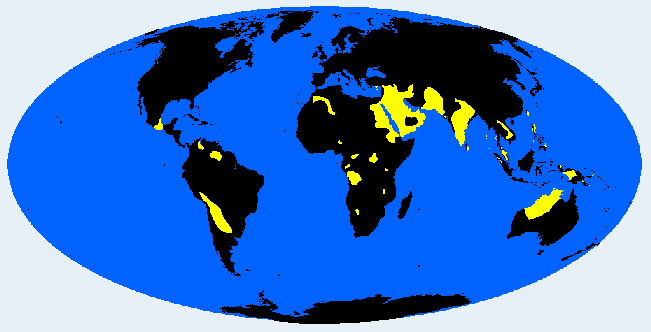
small-headed distribution

small-headed

Small-headed groups are charcterised by a sum of head length and head breadth of less than 330 mm. This sum reaches only 316 mm in the Kurumba, a pred. Malid group of South India. It is only slightly higher in several groups of South Arabia and groups of the Indus plain and South India. Several pygmies like the Andamanese, Bambutids, Aeta, Semang, and New Guinean Pygmies reach only a small head size. In Africa small heads are also present in some taller groups of North Angola as well as South Sudan and South Egypt. It appears in several desert groups of the Near East, and among Australian Aborigines of Arnhem Land and some New Guineans. It is typical for Veddoids of Sri Lanka, India, and even Indonesia. The mountain forests of Cambodia and Vietnam contain some Veddoid small-headed groups as well. In America some people of the Andes, Southern Mexico, and North Venezuela / Colombia are small-headed.
large-headed distribution

large-headed

Large-headed groups are charcterised by a sum of head length and head breadth reaching at least 350 mm. Very large heads with values above 355 mm are found in Northern Europe, here especially in Borreby, Paleo Atlantid, and Dalo Faelid types. It was one reason for some authors to place them in their own Cromagnid or Upper Paleolithic race. Equally large or even larger heads are found in Patagonians (357 mm in Ona) and Algonquian natives of America. Only slightly smaller are the heads of Fuegians and some Plains Indians. In North Asia large heads with values slightly above 350 mm are typical for some Tungusic and Siberian groups, but also Ainu. Sporadically large heads also appear in the Balkans, the Caucasus, and in Kurds, Inuit, and Polynesia (Mangaia of the Cook Islands reach 350 mm, Murrayians of South Australia reach 348 mm). In Africa the largest-headed group are the Bamum with a sum of 349 mm.