HumanPhenotypes
Anthropometric trait

Eye Folds

no fold

no fold

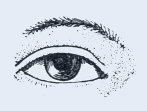
Many populations in Europe, South Asia, Africa, and Australia do not show any significant eye fold. However, the shape of the lids may significantly differ among anthropological groups, and give them their own expression, e.g. in Northern Europe the lid is usually spindle-shaped, while in Arabia it is almond-shaped. In Indids the lid opening is rather large, while in some Europeans (e.g. Faelids) it is rather small. Females tend to have larger lid openings. Sometimes eyes without any fold may appear slanted as well, e.g. in some Cambodians.
The most well-known and probably most widespread eye fold is the Mongolian fold. Sometimes erroneously confused with the epicanthus, although both folds often appear in combination. The Mongolian fold is characterised by the fold of the upper lid running along the whole length of the lid, so that it unites with nasal skin at the corner of the eye in a crescent-shaped arch. Sometimes the fold is so strong that the plica semilunaris is fully covered. Similarly, the eyelashes are partially covered. This gives the impression of slanting eyes and leads to a narrowing of the lid opening. E.g. Japanese have an average lid height of 8.8 mm while Europeans have 10 mm. In some cases, the lower lid shows a fold as well, this leads to the double Mongolian fold. In many individuals the Mongolian fold weakens in old age. It usually shows its strongest expression between the ages of 15 and 25 years and during childhood. The Mongolian fold does not only appear in Mongoloids. It may appear in Native Americans and even Africans (e.g. among Nilotids, Bantuids, Khoisanids, and Mangebtu), rarely Europeans, but in all those groups usually only in a weak form, where the fold is less persistent during adult age. Individuals of those ethnic groups who possess the Mongolian fold usually do not show other features of the Mongoloid eye. In the Mongoloid eye, the levator extends further down than in Europids and reaches the lid. In addition, the whole muscle is far thicker than in non-Mongoloids, and the whole lid contains more fat, which pushes the lash line deeper. Also, in Mongoloids the medial palpebral ligament is much longer and the whole orbit is higher. The Mongoloid fold is most likely an adaption to cold climate (during the last ice age), where fatty layers that pad the lids protect the eyeball. The narrow slit also protects the eye against snow glare.
The Indian fold, or internal fold, is characterised by an upper lid with its edge extending down along the inner lid. The lacrimal lake is often covered. In the Mongolian fold the edge of the eyelid is often covered by the fold, whereas in the Indian fold the edge of the eyelid itself produces the fold. Thus, the lid edge is composed of the lash-carrying section of the lid, and the eyelashes are fully visible (in difference to the Mongolian fold). This fold is particularly common among Native Americans, although those ethnic groups may show the Mongolian fold, the epicanthus, and other folds alternatively or in addition. However, in Native Americans the Mongolian fold often disappears during adult age, whereas the Indian fold does not. In some publications the Indian fold was erroneously confused with the Mongolian fold.
The epicanthus shows two varieties. The inner (medial) epicanthus is characterised by a fold covering the inner angle of the eye and the lacrimal gland. However, the upper and lower eyelids are not affected (like in e.g. the Mongolian fold). The lateral epicanthus behaves similarly at the outer edge of the eye. The epicanthus is often confused with the Mongolian fold. One reason may be that both folds often appear in combination. In this case the eye folds can cover a large portion of the eye. The epicanthic fold seems to appear often in individuals with mixed Mongoloid and non-Mongoloid ancestry, or is found in early childhood as a predecessor of the Mongolian fold.
The Hottentot fold (better: curtain fold) is characterised by a great amount of skin in the upper eyelid. This causes the skin to develop curtain-like wrinkles at the edges of the eyes. As a result, the eyelid aperture is as narrow as in Mongoloids. This fold is particularly common in Khoisan, where it often appears in combination with the Mongolian fold. It is also present in some Native Americans. It usually increases with age and is strongest in old people. The North European hanging fold shows similar patterns.
The laternal Negroid fold (better: laternal external fold) appears when the upper and lower eyelid at the outer edge of the eye do not meet in a usual way, but instead the upper eyelid extends towards the cheeks. Thus, the upper lid covers a small part of the lower eyelid as well as the outer angle of the eye. This causes a flat, often pleasant-looking area above the eye-angles. Another variation of the external fold, the medial external fold (or tarsal fold), shows the same pattern, but at the inner angle of the eye. These traits are common in Sub-Saharan Africa, but they also appear more sporadically in Europe and Native America.
The Nordic fold (better: hanging fold) is characterised by excessive skin that develops wrinkles at the edges of the eyes and covers a part of it. In difference to the Hottentot fold, it leads to a triangular eye shape and the area around the upper eye lid remains smooth. The North European hanging fold usually becomes stronger with age. It is not very common, but appears sporadically.