HumanPhenotypes
Anthropometric trait

Cephalic Index

The cephalic index, or breadth-length index, is probably the most prominent and popular anthropometric index of the skull. It has been studied in almost all populations of the world and has long played an important role in human classification. It is calculated by dividing the greatest breadth of the head by the greatest length of the head. The values vary from numbers as low as 60 to roughly 100. In short-headed groups females tend to have a slightly higher index, while in long-headed groups their index is marginally lower. The cephalic index varies greatly among anthropological groups and sometimes makes mountain populations differ from plains populations. Short-heads are found more frequently in cold climates of arctic regions and mountains, but there are many exceptions. The index is useful to distinguish local anthropological types, but not major racial groups. The individual variation is relatively small. It has been shown that the index changes with the environment and with time. E.g. since the early Middle Ages, brachycephaly increased significantly throughout Europe. However, since the mid 19th century it is continuously decreasing. The reasons are not known. Hence, the cephalic index is most useful to compare neighbouring groups in a similar environment of the same time period. For the reasons mentioned, the cephalic index should never be looked at alone, for interpretation usually head size and the height-length index should be considered in addition. On this site the cephalic index is divided into five categories: hyperdolichocephaly, dolichocephaly, mesocephaly, brachycephaly, and hyperbrachycephaly. The maps show regions where a specific cephalic index colour is dominant in native populations. On an individual level, it may regularly appear in the black areas as well. Apart from that, two other, more extreme categories exist on the individual level, but never for whole populations: ultrabrachycephaly and ultradolichocephaly.
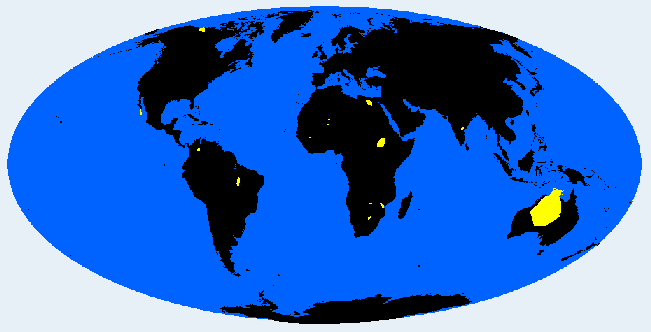
hyperdolichocephalic distribution

hyperdolichocephalic

Hyperdolichocephaly is characterised by the skull width reaching less than 71 percent of the skull breadth. It was found in some early humans, but is rare today on the population level. The largest area of hyperdolichocephalic dominance is found from Central Australia to North Australia (esp. Arnhem Land, Tiwi Islands). It dominates in some Nilotes (Nuer, Shilluk) and sporadically appears in North Africa (e.g. in Siwans). It has been found to dominate in the Chenchu of India, other Indian populations only reach hyperdolichocephaly on the individual level. In America it occurs in some western Inuit, some Lagids (U'wa, Tapuya), and was present in a very pronounced form in the extinct Pericú of Baja California.
dolichocephalic distribution

dolichocephalic

Dolichocephaly is characterised by the skull width reaching less than 76 percent of the skull breadth. It was widespread in many early humans, including Cro-Magnons and Neanderthals. Dolichocephaly is very common in many tropical populations today, especially throughout Africa, India, Australia, and New Guinea. Here it appears in all climate zones from rainforests to deserts, but not all groups are on average dolichocephalic. In Europe a few areas of Spain, South Italy, Scandinavia, and Great Britain have traditionally been dolichocephalic, although European dolichocephaly has recently increased. In America it appears in Inuit as well as some Lagid groups, in East Asia dolichocephaly appears only sporadically, more frequently only in Ainu.
mesocephalic distribution

mesocephalic

Mesocephaly is the most common ratio of skull length to skull width in the world today, but was rarer in prehistoric times. It is characterised by the skull width reaching less than 81 and at least 76 percent of the skull breadth. Mesocephalic groups are common on all continents except Australia. In Africa, many forest groups and some savannah groups like Bobo and Shari show mesocephaly, but also people of Madagascar. It is common in Northern Europe and the Mediterranean, South Arabia, West India, much of China, Japan, Indonesia, and Siberia. It occurs in Western Polynesians and New Guineans. In North America, Silvid groups as well as those of the Mexican steppes show mesocephaly. It is common in the Amazon rainforest and in Fuegians.
brachycephalic distribution

brachycephalic

Brachycephaly is characterised by the skull width reaching more than 81 percent of the skull breadth. It developed relatively recently through various processes of brachycephalisation around the world. It is most common in Europe, Asia, and America, often, but not always in cold climate. In Africa it is sporadically found in some populations of the Congo forest, more rarely in savannahs (e.g. in Shari) as well as the interior of Madagascar. In Central and Eastern Europe brachycephaly dominates, just like in Turkey, Central Asia, and Korea. Brachycephaly is common in many valley and coastal populations of Indochina and the Sunda Islands as well as in East Polynesia. In America it is found in the natives of the Pacific forest, around the Caribbean, in Central America as well as the Andes and Patagonia.
hyperbrachycephalic distribution

hyperbrachycephalic

Hyperbrachycephaly is characterised by the skull width reaching at least 85.5 percent of the skull breadth. The highest population means ever measured reach values close to 90 (e.g. in Sumo of Central America). On the individual level, ultrabrachycephaly may appear with a cephalic index of at least 91. In evolutionary terms, such round skulls are a relatively recent phenomenon in humans. It seems to appear in different climate zones, e.g. in Europe among French Alpines, Montenegrin Dinarics, and Scandinavian Saami, in the Central Asian steppes among some Turkic people, and Armenoids of Turkey and the Caucasus. In tropical regions, hyperbrachycephals are found in Lao and Thai of the plains as well as Central Americans (Sumo, Paya, Cuna, Totonachi...). In North America, hyperbrachycephals have been identified in Pueblids (e.g. Mohave) as well as Pacifids (e.g. Chilcotin). They may also have been typical for some extinct Patagonians.