Besides height and limb length, body types vary greatly among different indigenous peoples. For body type, besides height and cormic index, body weight, body fat, and muscularity play a role. Despite clothing, human body types follow the principles of thermal regulation, Allen's rule and Bergmann's rule. Allen's rule says that the body shapes and proportions of endotherms vary by climatic temperature by either minimising exposed surface area to minimise heat loss in cold climates, or maximising exposed surface area to maximise heat loss in hot climates. Bergmann's rule states that within a broadly distributed taxonomic clade, populations of larger size are found in colder environments, and species of smaller size are found in warmer regions. Allen's rule can partially be seen when one looks at Rohrer's index (weight/height^3). A low Rohrer's index will indicate a very slender build, a high Rohrer's index a very thickset built. The highest Rohrer's index is found in Inuit of North Canada and Alaska, the lowest in Nilotes living around the Upper Nile. In contrast, Kaup's index (better known as body mass index, BMI) (weight/height^2) shows Bergman's rule as it rises with overall size of the individuals. It reaches high values in Inuit, Polynesians, and Patagonians, very low values in Khoisan of the Kalahari desert. Besides thermal regulation, other factors have played a role, e.g. bow hunting and spear hunting strategies, the frequency of famines, and the use of agriculture. There have been various categories defined for body types. Ernst Kretschmer defined asthenic/leptosomic (thin, small), athletic (muscular, large-boned), and pyknic (stocky, fat). William Sheldon's somatotypes ectomorph, mesomorph, and endomorph are similar, but not identical. There have been various extensions and modifications of those typologies. Sheldon's types are used here in a slightly modified manner to illustrate the common body type of anthropological groups. The pictures illustrate very extreme examples of individuals with European ancestry. Most groups will not show such extreme expression of body type. It is important to note that the body types defined here refer to the indigenous groups given a natural nutrition. Western nutrition has been established in Native America and Polynesia and significantly increased the local Kaups and Rohrer indices as those populations are less adapted to this type of nutrition. One should note that usually all body types can appear in all populations, just at different proportions. E.g. there may be very slender, muscular Mongols even though endomorphy is more common in Mongolia. However, there exist almost no short, stocky Nilotes.
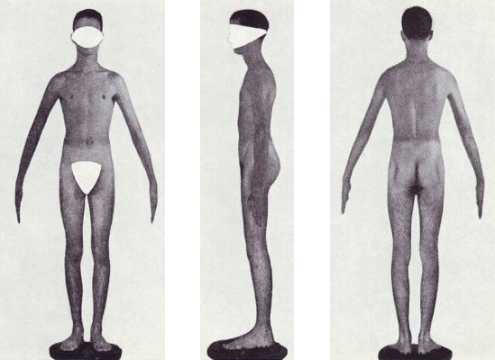 ectomorph